What dye-sublimation cannot do
Every print process has edges. Most shops mention them in the small print of a returns page, after the money has moved. Ours are on their own page, with photographs and a measurement, because they are the four things that decide whether you will be happy with what arrives.
It only works on polyester
Sublimation uses disperse dye. Under heat it turns from solid straight to gas, enters the polymer chain of a polyester fibre and bonds inside it. That is why a sublimation print has no hand — there is nothing sitting on the surface to feel, to crack, or to peel away in the wash.
Cotton has no polymer chain for the gas to enter. The dye lands on it, sits there, and rinses out on the first wash. So a blend prints at roughly the strength of its polyester fraction, and pure cotton does not print at all.
Our two hard rules follow from that, and the configurator enforces them:
- Below 65% polyester we will not sell an all-over print. The dye load across a full wrap becomes too uneven to look deliberate.
- Below 50% polyester we will not sublimate the blank at all.
These are not preferences. They are written into src/lib/guards.ts and re-checked on our server when an order is created, so the combination cannot be bought even by going around the interface.
It can only darken the cloth
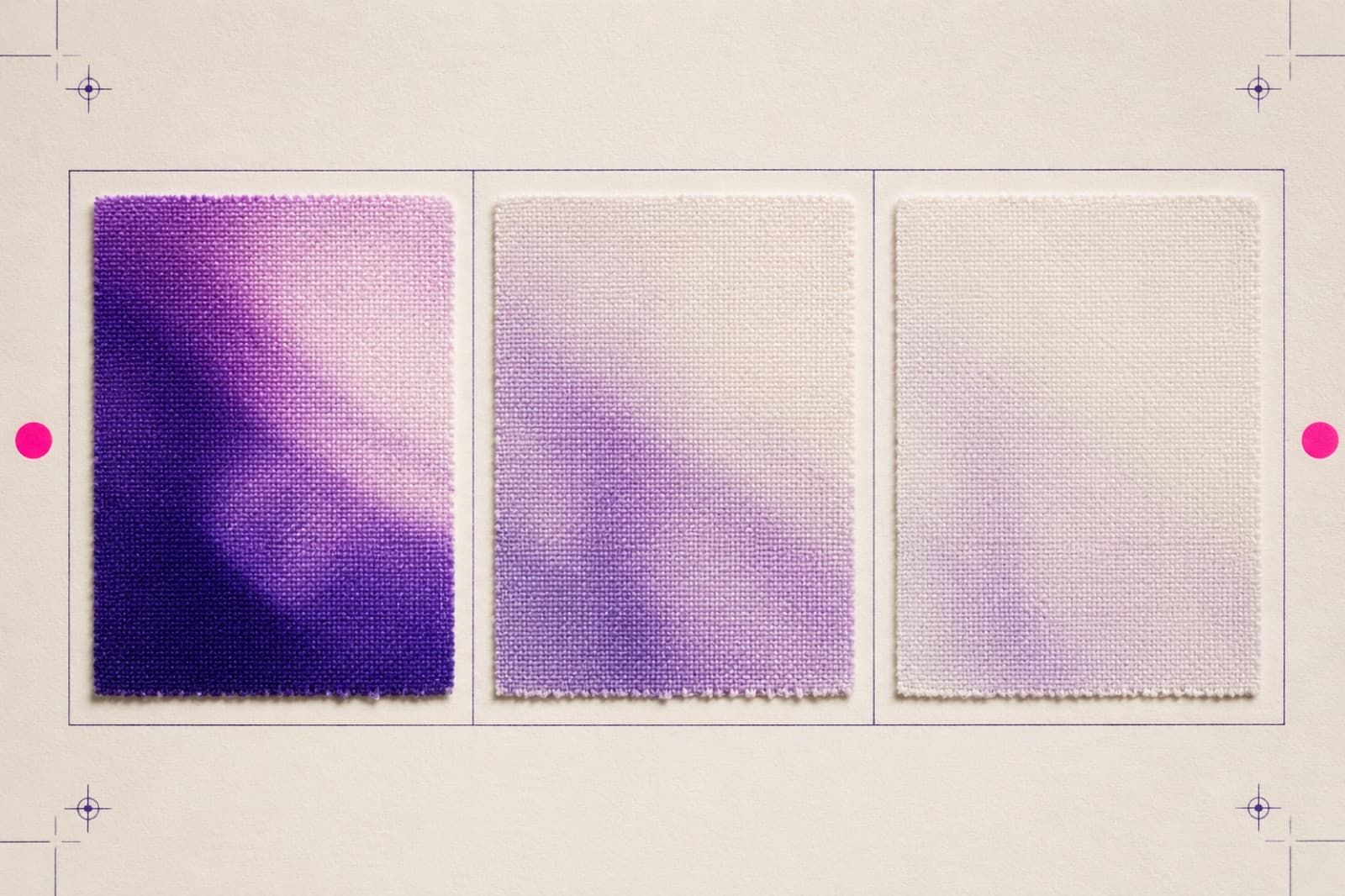
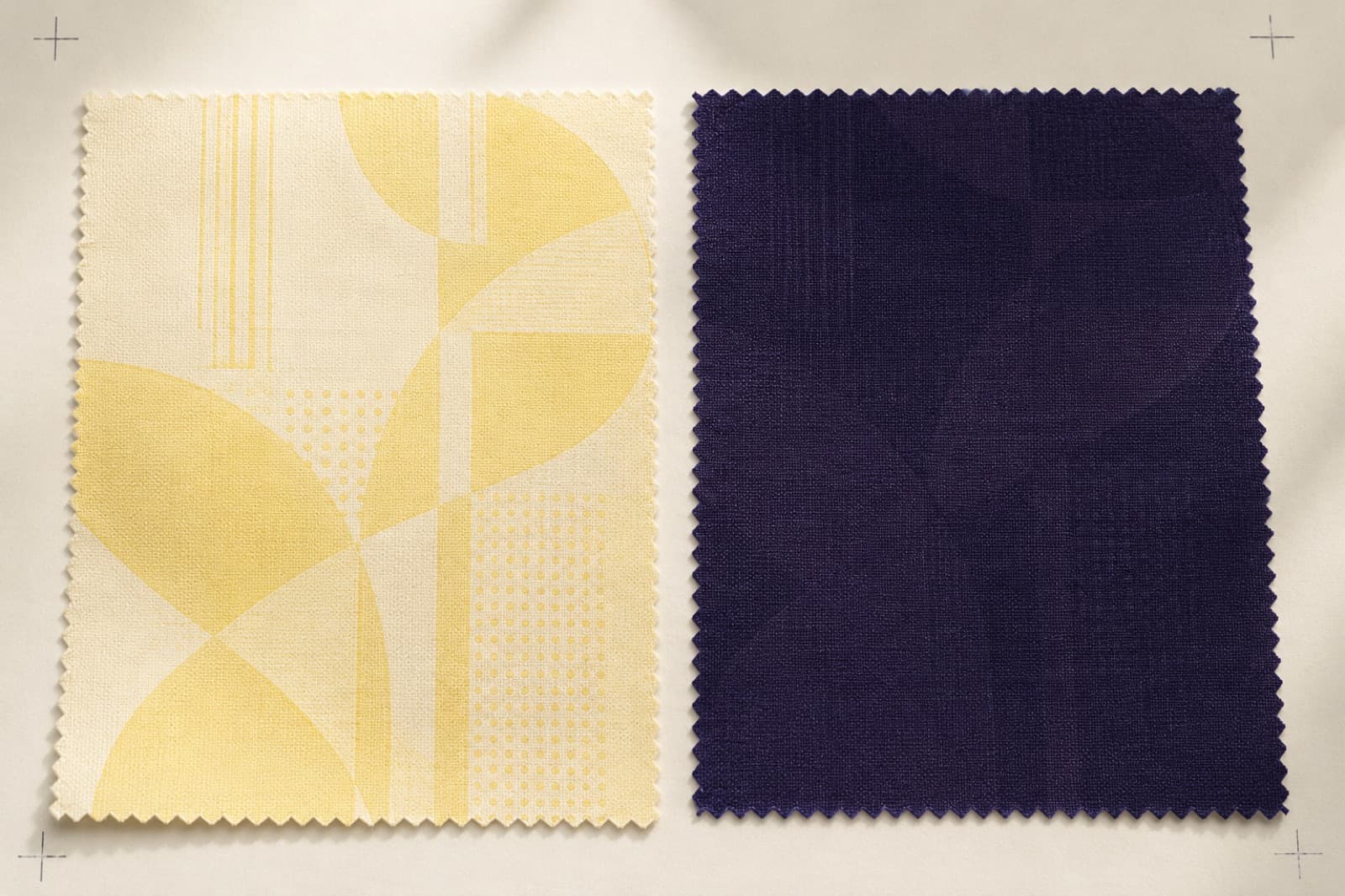
Disperse dye is translucent. There is no white ink in sublimation, and there is no opaque layer — the colour you see is the dye and the cloth beneath it, together.
So the substrate sets your lightest possible tone. On optic white you have the full range. On a pale heather you lose the brightest highlights. On a deep navy, everything in your file lighter than the navy simply does not appear: not faint, not subtle — absent.
Where a blank offers a dark base, the studio simulates it honestly. The preview multiplies your artwork into the substrate colour the way the dye does, and the gamut check counts every pixel lighter than the blank as unreproducible, marking it in the same fluorescent magenta as the rest.
Seams whiten, and we are not going to retouch it out
An all-over print is pressed onto a garment that has already been sewn together. Wherever cloth folds, doubles or sits over a seam allowance, the press cannot apply even pressure — and where pressure drops, so does dye transfer. The result is a fine pale speckle along the seam.
It is worst on hoods, kangaroo pockets, cuffs, underarms and any collar join. It is mildest on flat, single-layer pieces: flags, banners, gaiters and wall hangings, which have almost no interior structure at all.
Three things follow, and all three are on the site:
- Every blank carries a graded seam risk — low, medium or high — and a list of the specific zones.
- The studio draws those zones over your artwork at step 4, so you can see what crosses them before you commit.
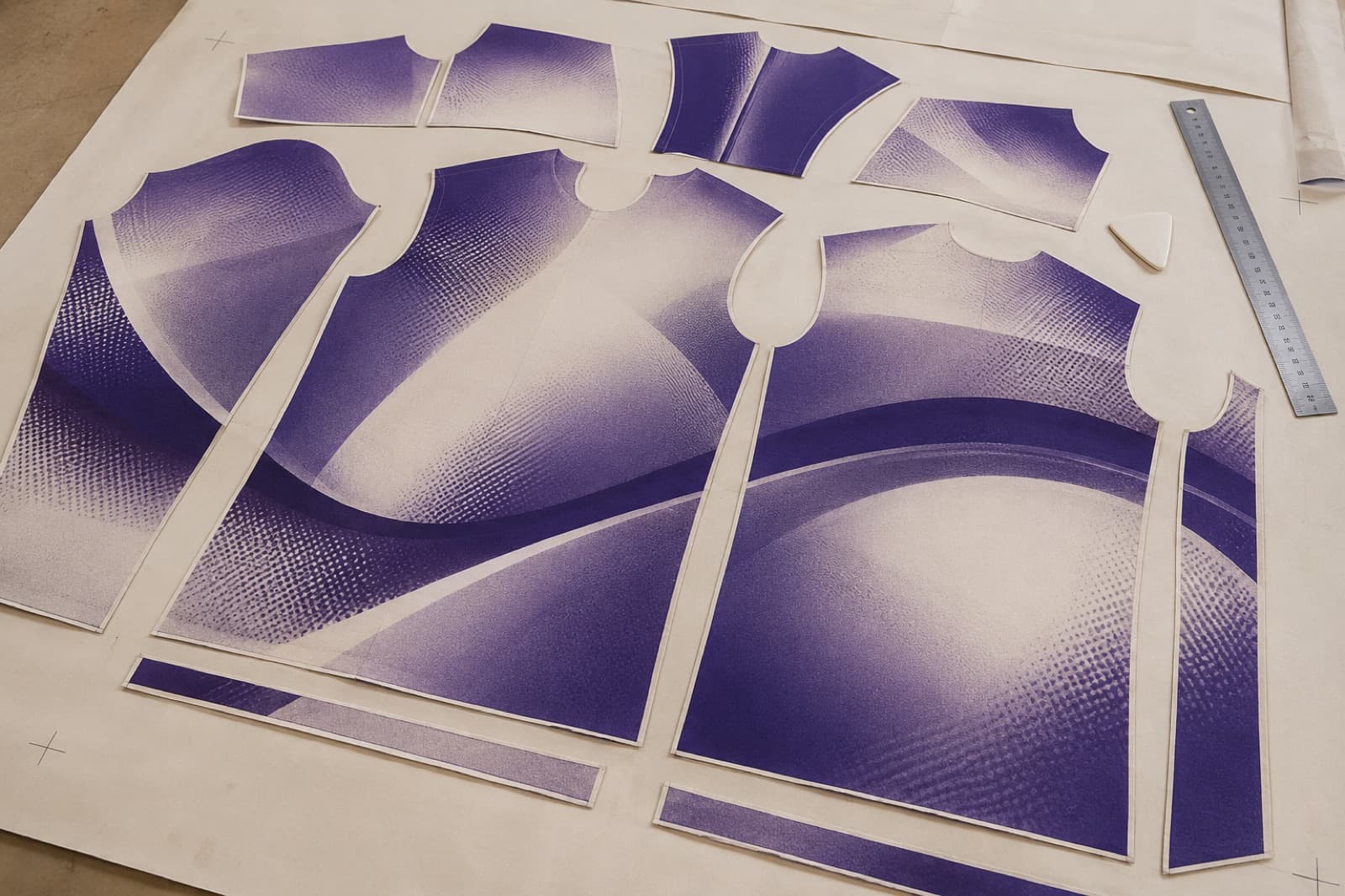
- Panel-cut printing is the genuine solution: the pattern pieces go through the press flat and are sewn afterwards, so there is nothing folded for the press to miss. It costs more and needs twelve pieces, and we would rather tell you that than pretend the problem does not exist.
Your screen can show colours no dye can make
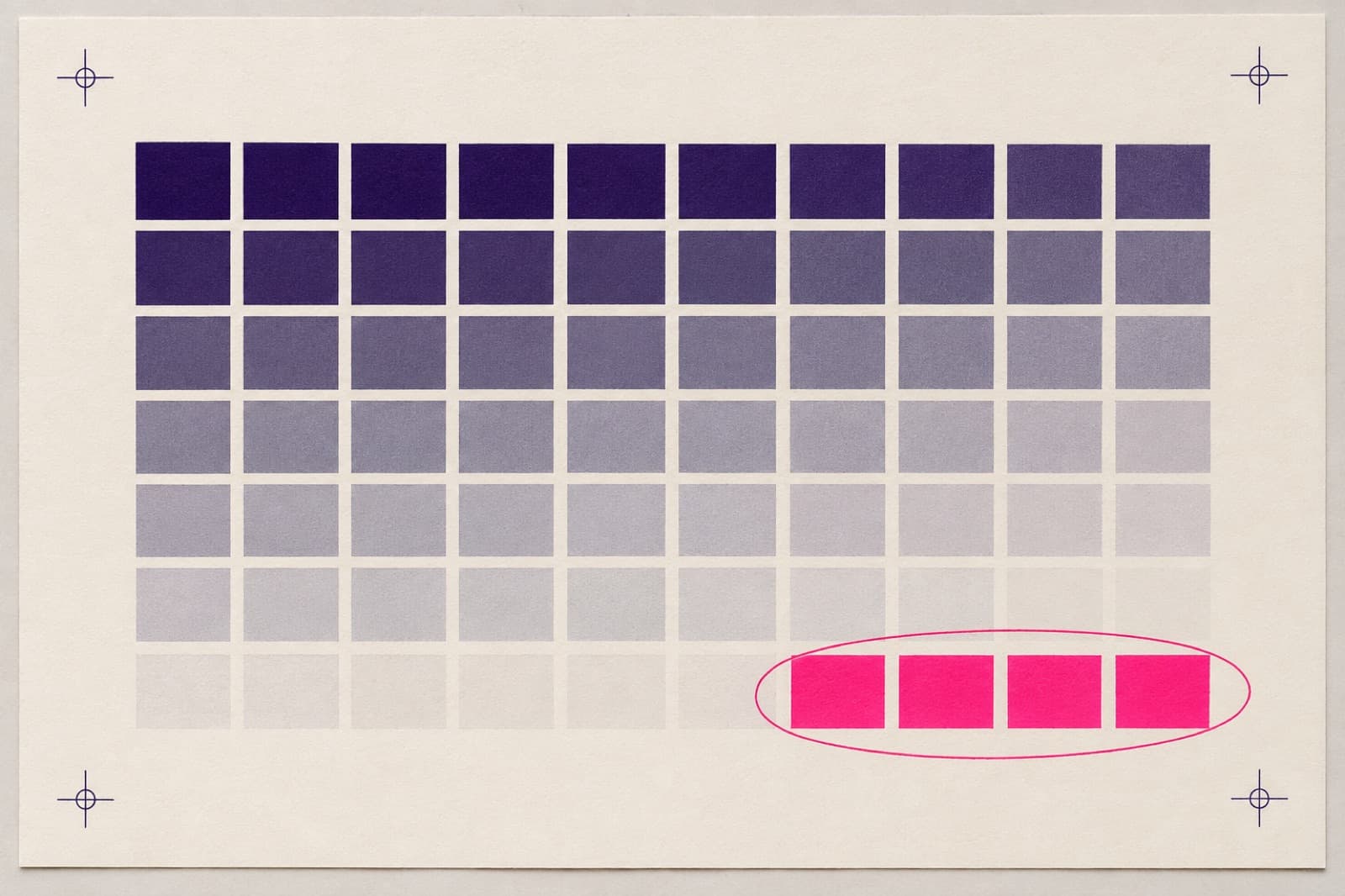
A monitor emits light. Cloth reflects it. That difference alone puts a set of colours permanently out of reach: fluorescents, the most saturated blues and violets, the purest cyans, and a genuine black. Sublimation on polyester covers more than conventional four-colour offset does, but it is still narrower than the sRGB space your file lives in.
How the Gamut Check actually works
When you upload a file, your browser rasterises it, converts every sampled pixel from sRGB into OKLab — a perceptually uniform space, so a numeric distance means what your eye means — and tests each one against three limits:
- A chroma ceiling that varies with hue and lightness. Cyan has the lowest ceiling in the dye set; magenta the highest.
- A black floor. Below it, every value converges on the same deep charcoal, so detail in the shadows disappears.
- A substrate ceiling, applied only on dark blanks: anything lighter than the cloth cannot appear.
The percentage is the share of pixels that pass all three. The magenta halftone over the preview is the pixels that failed. The written summary names the colour families involved, because a mark on an image is no use to someone using a screen reader.
The ceilings are deliberately conservative — we would rather flag a colour that would have printed than take money for one that would not. It is an estimate computed from your file, not a spectrophotometer reading of a physical proof, and we say so everywhere the number appears. If a colour matters that much, order a sample piece first; the fee comes off the full order.
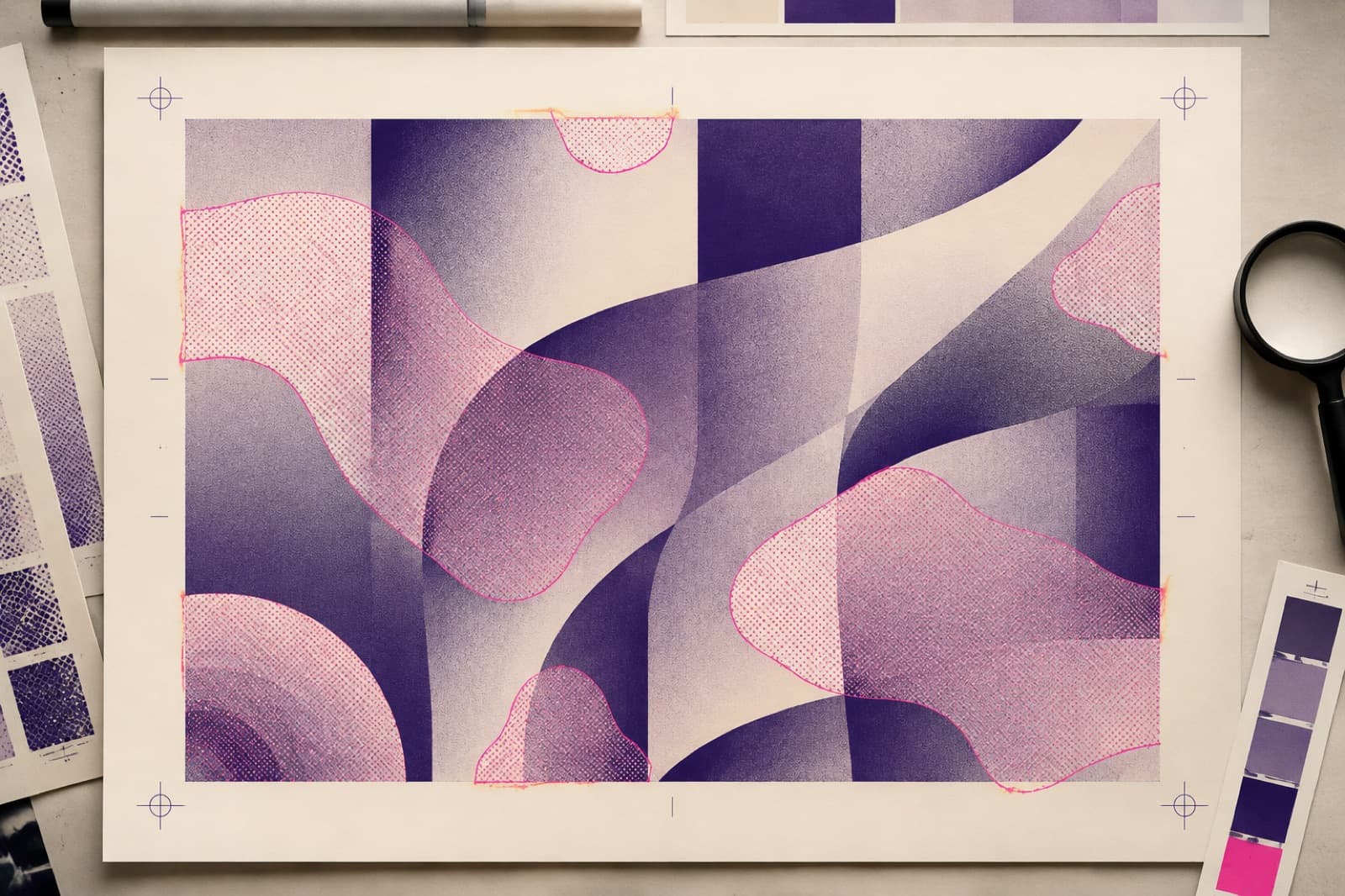
The marker colour is a fluorescent magenta that this process cannot reproduce. We use a colour the press cannot hit to mark the colours your file contains that the press cannot hit. It is the only place on this site that colour appears, apart from the withdrawal-rights alert — so when you see it, it means something specific.
What a blend costs you, blank by blank
Colour strength tracks polyester content almost linearly. These are the blanks in our catalogue that are not effectively pure polyester, with the loss we quote against each. We quote the pessimistic end of what we measure.
| Blank | Composition | Polyester | Expected colour loss |
|---|---|---|---|
| Compression Long-Sleeve | 85% polyester, 15% elastane | 85% | ≈ 14% lighter |
| Sock, Polyester Blend | 78% polyester, 18% polyamide, 4% elastane | 78% | ≈ 20% lighter |
| Beach Towel 70 × 140 cm | 70% polyester, 30% cotton; polyester velour printed face, cotton loop reverse | 70% | ≈ 27% lighter |
| Sublimation Tee Poly-Cotton 65/35 | 65% polyester, 35% cotton | 65% | ≈ 32% lighter |
Every other blank in the catalogue is 95% polyester or above and prints at full strength. See all 38 blanks.
Sublimation against the alternatives
Sublimation is not the right process for every job, and we would rather say so than take an order we know will disappoint. If your job is in the right column, we are not the right supplier for it.
| Dye sublimation | Screen print | Heat-transfer vinyl | DTG | |
|---|---|---|---|---|
| Fabric | Polyester only | Most fabrics | Most fabrics | Cotton preferred |
| Base colour | Light only | Any | Any | Any (with underbase) |
| Hand feel | None — dye is in the fibre | Slight to heavy | Distinctly raised | Slight |
| Full colour photos | Yes | Costly | No | Yes |
| Edge to edge | Yes | Rare | No | No |
| Cracks or peels | No layer to crack | Can crack | Can lift | Can fade |
| Cotton t-shirt | Not suitable | Suitable | Suitable | Suitable |
Claims we do not make
These sentences appear nowhere on this site, and a build-time check fails the deployment if any of them ever creeps in:
- that we achieve a 100% colour match to your screen;
- that the print never fades;
- that the print never cracks — there is no layer to crack, but the cloth itself still ages;
- that we can print any artwork;
- that we can print on any fabric;
- that a custom order can never be refunded;
- that the finished garment is crease-proof, waterproof, antibacterial or deodorising.
What we will say is narrower and testable: the dye sits inside the fibre, so there is no surface layer to crack or peel; the hand of the cloth is unchanged; and washing does not lift the image the way it lifts a transfer. Beyond that, the honest answer is on this page.
Important — If in doubt, prove it on one piece
A single sample is the cheapest way to settle any of this. The sampling fee is credited in full against the order when you go ahead, so proving it costs you nothing but time.